Over 100 works spanning 110 years feature a diverse range of portraits, landscapes and sculpture with a roll-call of modern masters, past and present, including Pablo Picasso, Dorothea Tanning, Elisabeth Frink, John Bellany, Barbara Rae and Damien Hirst, to name just a few. Each room is given a theme or genre – places, people, Cubism, Surrealism – in a well-curated journey through the decades.
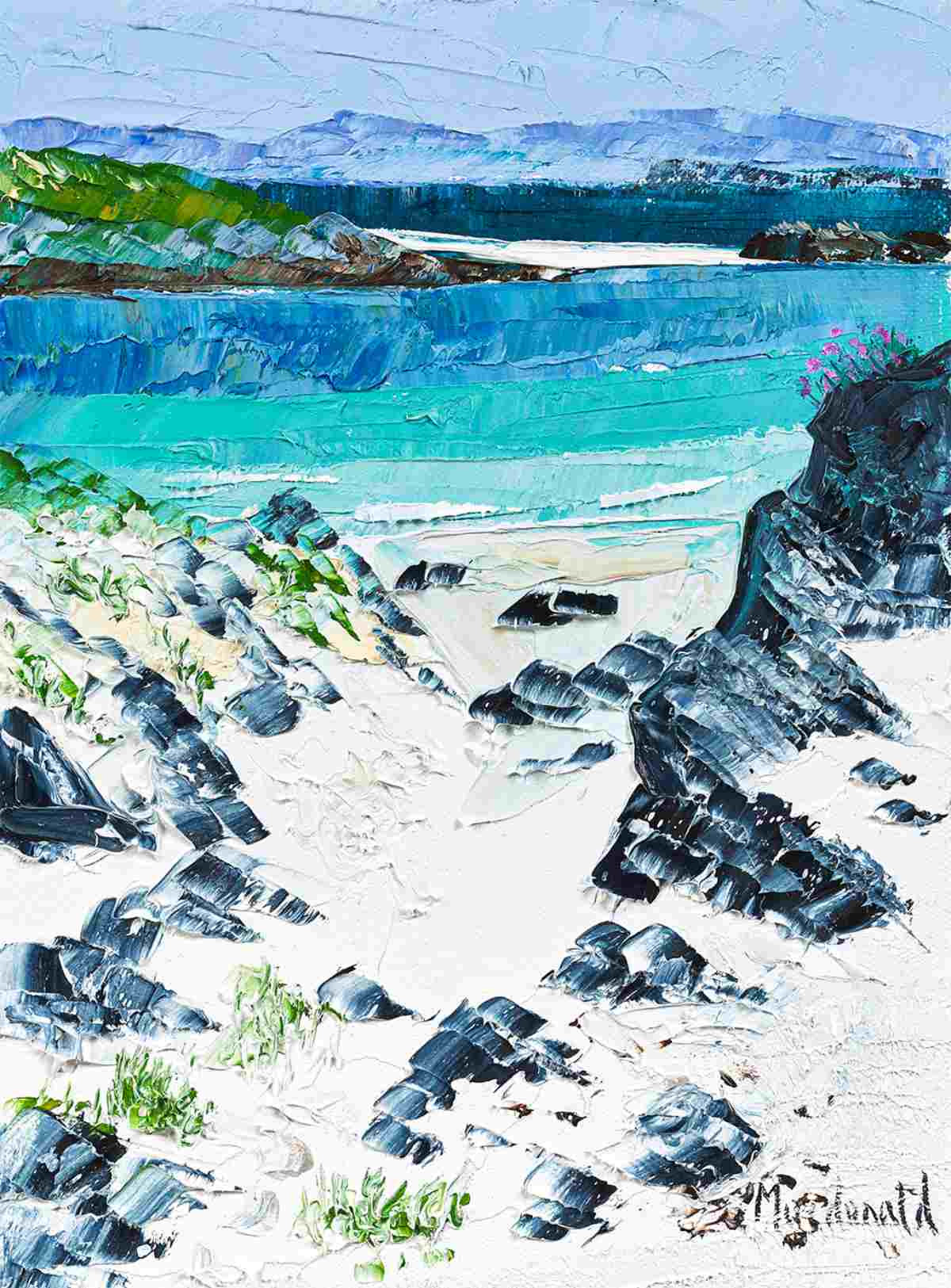
 Frances Walker, ‘Summer day in the Dunes’, oil on canvas
Take a trip to Tiree for a Summer Day in the Dunes (1994) by Frances Walker, where the rippled sand is echoed by the waves, all softly bathed in sunlight. The tiny figure and boat give a perfect perspective as you gaze out to sea.
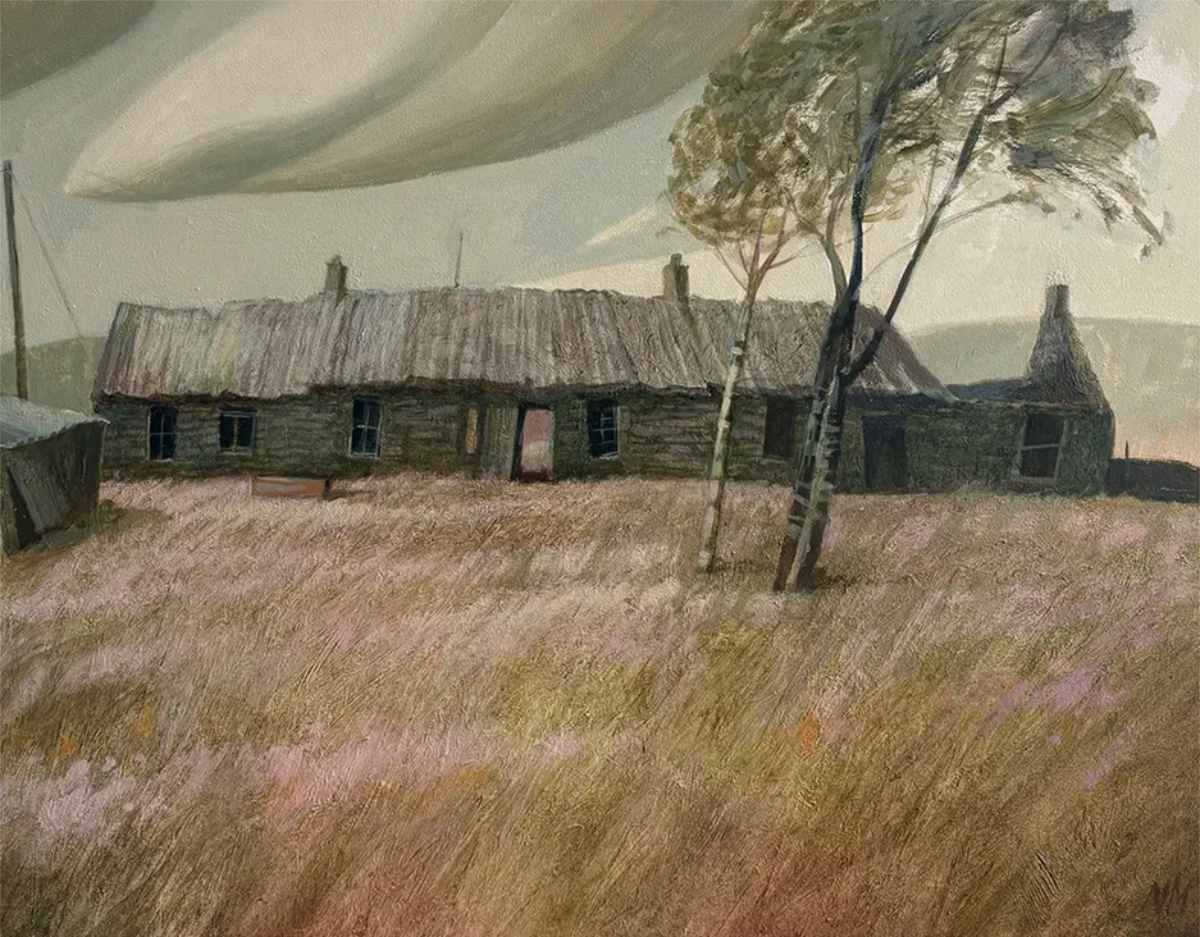
 James Morrison, ‘For a Lady Remembered’, oil on board
In contrast, James Morrison’s For a Lady Remembered, (2007), is a dramatic stormy day and refers to his wife, Dorothy, who had died the previous year after fifty years of marriage.
 Barbara Rae, ‘Light at Jacobshavn’, acrylic and mixed media on handmade cotton rag paper
Barbara Rae took several Arctic expeditions through the Northwest Passage captured in evocative paintings, such as Light at Jacobshavn (2016), the silver tones of cracking, melting ice and bold blue skies.
 Gwen John, ‘Portrait of a Girl in Grey’, oil on canvas laid on plywood
Emigration is the focus of a few works – Gwen John’s quiet, thoughtful Portrait of a Girl in Grey, (1918 – 23), travelling to a strange land perhaps, her hand clutching a rosary for comfort.
 Oskar Kokoshka, ‘Self-Portrait of a Degenerate Artist’, oil on canvas
Oskar Kokoschka arrived in Britain as a refugee in 1939 after Nazi Germany included his work in an exhibition to showcase ‘Degenerate Art’. This prompted his most famous self-portrait, his hands folded in defiance and the running figure, a hunted man.
 John Bellany, ‘Helen’, watercolour on paper
John Bellany’s model was often his wife Helen: ‘I was his muse. Sometimes he wasn’t even aware of it – my face was a pattern on his visual cortex’. Simply entitled Helen, (1989), here is a red haired goddess in a trademark mythical seascape and glowing halo of moonlight.
 Marc Chagall, ‘L’Écuyère (The Horse Rider)’, gouache on paper
Ambroise Vollard commissioned Marc Chagall for a circus-themed project and this became a recurring theme. L’Écuyère, 1949-53 features a clown, trapeze artist and pretty young horse rider, as an allegorical fantasy.
 Salvador Dalí and Edward James, ‘Lobster Telephone’, painted plaster and Bakelite telephone
The NGS Surrealist collection is highly-regarded and now includes Salvador Dalí’s iconic Lobster Telephone (1938). This shellfish is a popular subject for artists (e.g. Delacroix, Picasso, Koons), but Dalì presents a cool and quirky creation.
 Dorothea Tanning, ‘Tableau Vivant’, oil on canvas
 Dorothea Tanning, ‘Primitive Seating’, Fabric, upholstered wood chair, and wool
After her marriage to Max Ernst, Dorothea Tanning painted Tableau Vivant (1954), depicting a giant image of Ernst’s dog, Katchina, a Tibetan Lhasa Apso, embracing a nude female figure: ‘If I gave Katchina a human dimension, it is because I see her that way… a reflection on the hilarity of appearances.’ To illustrate her imaginative artistry, Primitive Seating (1982) by Tanning is a fabulous Ocelot/Clouded Leopard, animal print-covered chair – ‘I had some material left over, so I put a tail on it.’ (I wish replica chairs were available in the NGS shop!)
 Pablo Picasso, ‘Bouteille et Verre sur un Table’, charcoal on paper, collage
Pablo Picasso experimented with his first collage at the end of 1912. In Bouteille et Verre sur un Table, the bottle is a scrap of a newspaper advert promoting an aperitif, Cherry Rocher and OLD / JA / R refers to Old Jamaica Rum.
 Elisabeth Frink, ‘Birdman’, bronze sculpture
Elisabeth Frink developed her own genre of sculptured birds, animals, male figures and hybrid creatures such as Birdman (1960) to explore masculinity and our place in the natural world.
 Damien Hirst, ‘Wretched War’, bronze sculpture
Damien Hirst is able to surprise, shock and amuse through provocative, questioning narratives. Wretched War (2004) depicts a pregnant, decapitated woman, her balletic pose akin to Degas’ Little Dancer, to express feminine grace and beauty on the battlefield.
 Jenny Saville, ‘Nude, Study for Branded’, oil on paper
Jenny Saville approaches the female nude afresh with all blemishes and fleshy folds in contrast to the idealised image of femininity. Nude, Study for‘Branded, (1992) is a curvaceous, naked woman, au naturel: ‘Flesh is just the most beautiful thing to paint.’
 Bridget Riley, ‘Intervals 2’, oil on canvas
From the early 1960s, Bridget Riley was a pioneer of Op(tical) Art, moving from simple black and white shapes to dazzling stripes and colourful, curving waves. Intervals 2 (2019) illustrates her constant experimentation in geometric abstraction.
 Alberta Whittle, ‘Secreting Myths, golden yellow’, woodblock print
Following Reset, a poetic, film installation at Jupiter Artland/EAF 2021, Alberta Whittle will represent Scotland at the 59th International Venice Biennale. Influenced by her Caribbean colonial heritage, Secreting Myths (2019) is a group of delicately-crafted prints.
‘Acquisitions breathe new life to reflect the latest developments in Scotland and beyond. Thanks to gifts, bequests, charitable funds and private donors, the National collection continues to grow in exciting new directions.’ – Simon Groom, Director of Modern and Contemporary Art, National Galleries of Scotland.
This New Arrivals exhibition is due to the generosity of art collectors, donors and trusts including Iain Paul, The Henry and Sula Walton Fund, the Drue Heinz Estate, Denise Coates, Brian and Lesley Knox and Patrons of NGS, and represents a selection of the recent works purchased by the NGS – an evolving collection with further acquisitions to be displayed.
Admission is free, but advance booking is recommended.
With thanks from Artmag to Vivien Devlin for this review. Images courtesy National Galleries Scotland.